Common pool resource harvesting
Main contributors: Maja Schlüter, Steven Lade
Other contributors: Alessandro Tavoni, Simon Levin
Last update: 2014-09-18
A community derives ecosystem services by extracting from a renewable resource such as water, fish, or forest. If a harvester is overharvesting (a defector), he/she is ostracised by the community, for example by obstructing their access to necessary machinery or to market, which encourages the defector to co-operate by harvesting at a lower, socially optimal level. The alternative regimes are (1) high co-operation and resource levels and (2) overharvesting. Key drivers include resource inflow, the effectiveness of the ostracism norm, and the cost of harvesting. Key impacts include degradation in the state of the resource and harvester payoff and wellbeing. Evidence is currently confined to modelling studies.
Evidence
Fig 1 | Empirical evidence. The databse currently documents 1 cases of common pool resource harvesting around the world. Each dot in the map is coded from a scientific article documenting a place undergoing this regime shift. You can learn more from each case by hovering and clicking on the case of interest.
Analysis
General information
Alternative regimes
Co-operation and sustainable resource levels
Harvesters extract from the resource at rates that are socially optimal, ensuring that resource levels stay at their most productive level and the community-average payoff is high. Social capital exists within the community, ensuring any defectors are ostracised.
Over-harvesting
Harvesters exert high efforts in extracting the resource, leading to depletion of the resource and low payoffs for the community. Social capital is absent and defectors are not ostracised.
Drivers and causes of the regime shift
Shift from ‘Co-operation and sustainable resource levels’ to ‘Over-harvesting’
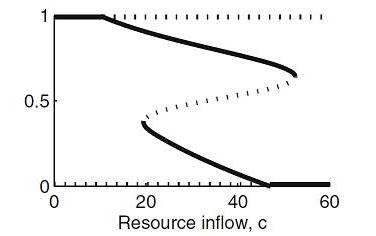
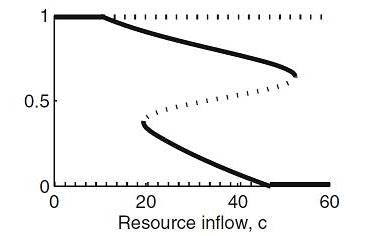
The regime shift occurs when ostracism ceases to be an effective mechanism for encouraging defectors to co-operate, because the benefits of overharvesting begin to outweigh the disadvantages of ostracism. A number of factors could drive this shift. Increasing resource level, for example due to increased inflow, can lead to ineffective ostracism because at higher resource levels defection becomes more attractive by providing higher gains from resource over-extraction. Increasing defector payoff compared to ostracism, for example due to decreased costs or decreased ostracism strength, could also lead to defection becoming increasingly attractive.
Shift from ‘Over-harvesting’ to ‘Co-operation and sustainable resource levels’
Reversal of any of the above trends can cause a shift from over-harvesting to co-operation: decrease in resource levels, for example due to decreased inflow; increased costs; or increased ostracism strength.
Impacts on ecosystem services and human well-being
The ability of the natural system to provide resources for harvesting is lost with the regime shift from co-operation to over-harvesting (gained for over-harvesting to co-operation). Depending on context, loss of other ecosystem services many accompany the decline in resources. The income that members of the harvesting community obtain by harvesting is severely decreased by this regime shift. Income may even no longer exceed the costs of harvesting and the community may need to find other means of survival.
Management options
Options for preventing regime shift to over-harvesting
Management actions that stop the drivers discussed above reaching their thresholds may help to prevent regime shifts. Activities that strengthen social norms and trust in the community and thus enhance cooperation and decrease the incentive to defect and overharvest for the individual benefit (hence increasing the strength of the ostracism).
Options for restoration of co-operation:
Introducing measures that build trust in the community and disincentivise free riding.
In-depth analysis
[1] “This regime shift does not have a feedback analysis yet”
Categorical summary
Impacts
Ecosystem type:’
- Marine & coastal
- Freshwater lakes & rivers
- Temperate & boreal forests
- Tropical forests
- Moist savannas & woodlands
- Drylands & deserts
- Mediterranean shrub (Fynbos)
- Grasslands
- Tundra
- Polar
- Agro-ecosystems
Key ecosystem processes:
NA
Biodiversity:
- Biodiversity
Provisioning services:
- Freshwater
- Food crops
- Livestock
- Fisheries
- Wild animal and plant products
- Timber
- Woodfuel
- Fuel and fiber crops
- Hydropower
Regulating services:
NA
Cultural services:
NA
Human well-being:
- Livelihoods and economic activity
Links to other regime shifts:
NA
Drivers
Key drivers:
- Harvest and resource consumption or Environmental shocks (e.g. fire or floods or droughts)
Land use:
- Urban or Small-scale subsistence crop cultivation or Large-scale commercial crop cultivation or Intensive livestock production (e.g. feedlots or dairies) or Extensive livestock production (natural rangelands) or Timber production or Fisheries or Mining or Conservation or Tourism
Key attributes
Spatial scale:
- Local/landscape (e.g. lake or catchment or community)
Time scale:
- Weeks
- Months
- Years
- Decades
Reversibility:
- Hysteretic (difficult to reverse)
Evidence:
- Models
Confidence: existence of the regime shift
- Speculative – Regime shift has been proposed, but little evidence as yet
Confidence: mechanisms underlying the regime shift
- Contested – Multiple proposed mechanisms, reasonable evidence both for and against different mechanisms
References
References old [Delete]
- Lade SJ, Tavoni A, Levin SA & Schlüter M. 2013. Regime shifts in a social-ecological system. Journal of Theoretical Ecology 6:359-372.
- Tavoni A, Schlüter M, Levin S (2012), The survival of the conformist: Social pressure and renewable resource management, Journal of Theoretical Biology 299:152-161
Citation
Acknowledge this review as:
Maja Schlüter, Steven Lade, Alessandro Tavoni, Simon Levin. Common pool resource harvesting. In: Regime Shift Database, www.regimeshifts.org. Last revised: 2014-09-18BibTeX citation:
@misc{
  author = {Maja Schlüter and Steven LadeAlessandro Tavoni and Simon Levin},
  title = {Common pool resource harvesting},
  url = {www.regimeshifts.org},
  howpublished = {Regime Shifts Database},
  publisher = {Stockholm Resilience Centre},
  institution = {Stockholm University}
}
This work is licensed under CC BY-NC-SA 4.0


 . It is an initiative lead by the Stockholm Resilience Centre. The website was developed by Juan Rocha and build with Rmarkdown.