Regime Shifts


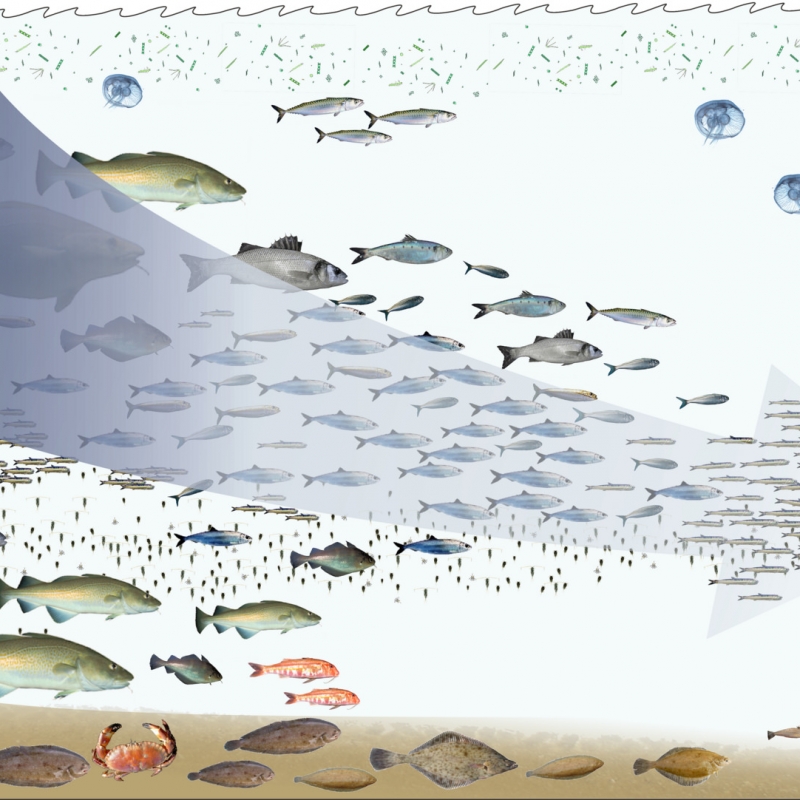
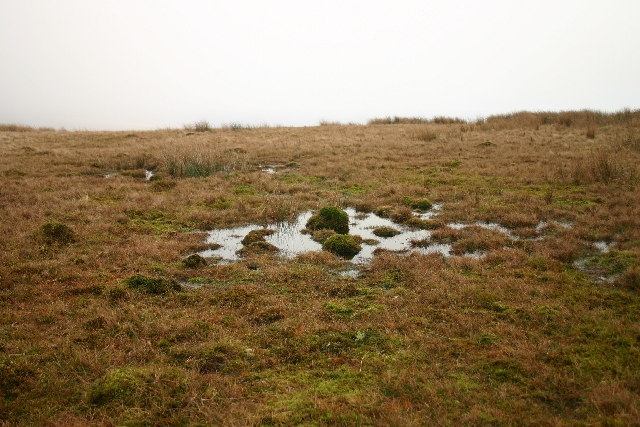
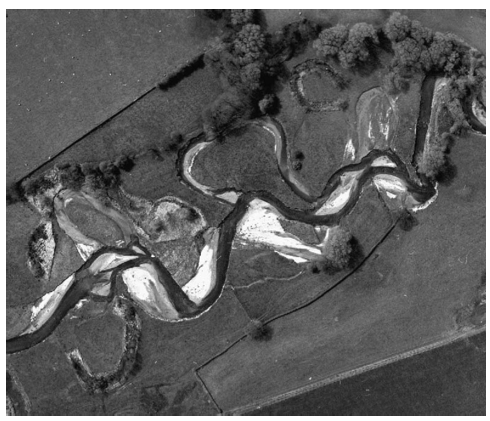
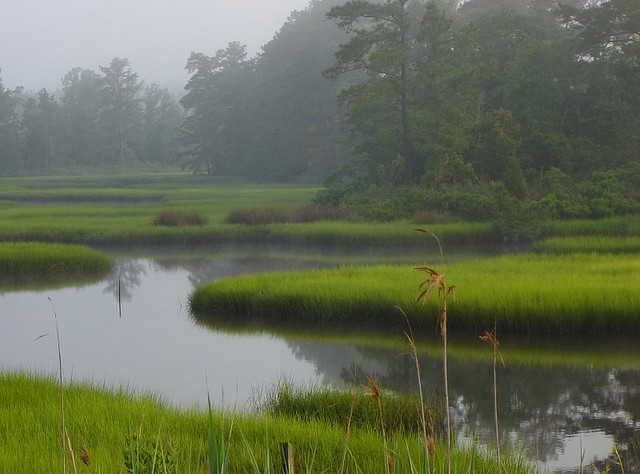

How do regime shifts work?
Different regimes can be metaphorically represented by a ball-and-cup diagram. The valleys or cups represent different regimes or fundamental ways in which the system can function and be structured. A regime shift entails a shift in the current system state (represented as a ball) from one cup or valley to another. While in a particular regime, it is important to note that the system does not remain stable but fluctuates around.
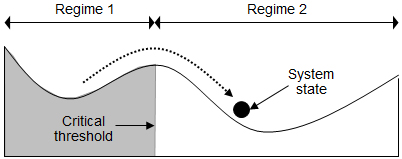
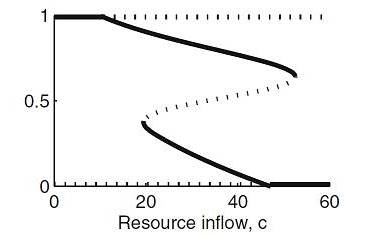
Regime shifts result from a change in the dominant feedbacks. All complex systems contain many feedback loops, but these can typically evolve and combine in only a limited number of ways. Over time, a particular combination of feedbacks will tend to become dominant, leading the system to self-organize into a particular structure and function – or “regime”. However, if the system experiences a large shock (eg a volcano) or persistent directional change (eg accumulation of pollutants, habitat loss) the dominant feedbacks may be overwhelmed or eroded. At some point a critical threshold may be passed where a different set of feedbacks become dominant, and the system experiences a large, often abrupt change in structure and function – or a “regime shift”.
Advanced search
Further reading
- Biggs R, Blenckner T, Folke C, Gordon L, Norström A, Nyström M & Peterson GD. 2011. Regime Shifts. In: Sourcebook in Theoretical Ecology. Hastings A & Gross L (eds). University of California Press, Berkeley.
- May RM, Levin SA, Sugihara G. 2008. Ecology for Bankers. Nature 451, 893-895.
- Scheffer M. 2009. Critical transitions in Nature and Society. Princeton University Press.
- Scheffer M, Carpenter SR, Foley JA, Folke C & Walker BH. 2001. Catastrophic shifts in ecosystems. Nature 413, 591-596.
Online resources:
- Regime Shifts: What are they and why do they matter? http://www.regimeshifts.org/datasets-resources/details/15/26
- Wikipedia: http://en.wikipedia.org/wiki/Regime_shift
- Resilience Alliance Thresholds Database: http://www.resalliance.org/index.php/thresholds_database
This work is licensed under CC BY-NC-SA 4.0


 . It is an initiative lead by the Stockholm Resilience Centre. The website was developed by Juan Rocha and build with Rmarkdown.