Greenland ice sheet collapse
Main contributors: Juan Carlos Rocha, Rolands Sadauskis
Other contributors: Reinette (Oonsie) Biggs, Garry Peterson
Last update: 2011-02-27
The great ice sheet of Greenland was, traditionally, believed to take thousands of years to respond to external forcing. Recent observations suggest, however, that major changes in the dynamics of parts of the ice sheet are taking place over timescales of years. Widespread thinning at rates generally exceeding those expected occur due to recent warmer summers as the atmospheric temperatures are rising. The main identified direct driver behind the loss of ice sheet volume is greenhouse gas emissions in atmosphere that initiate change in dominating reinforcing feedbacks. There are two initial feedback mechanisms that are maintaining the initial regime of the system – ice-albedo mechanism and meltwater-ice sliding mechanism. The options to prevent or reverse this potential regime shift mainly relate to the decrease of greenhouse gas input in to the atmosphere at a global scale.
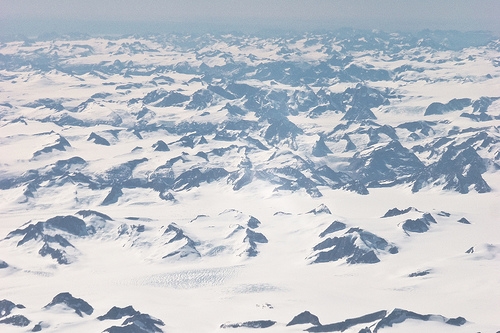

Evidence
Fig 1 | Empirical evidence. The databse currently documents 1 cases of greenland ice sheet collapse around the world. Each dot in the map is coded from a scientific article documenting a place undergoing this regime shift. You can learn more from each case by hovering and clicking on the case of interest.
Analysis
General information
Alternative regimes
The Greenland Ice Sheet (GIS) is approximately 1.7 million km2 in area covering approximately 80% of the surface of Greenland. It is grounded on bedrock that mostly rests near or above sea level thus would contribute to the globally averaged sea-level rise of 7.3 m if melted completely. [Parizek et al. 2004; Lemke et al. 2007]. Anticipated future warming of the climate system has the potential to permanently reduce large areas of GIS or even abate it completely. The evidence suggests nearly total ice-sheet loss may result from warming of more than a few degrees above mean 20th century values, but this threshold is poorly defined (perhaps as little as 2oC or more than7oC) [Alley et al. 2010].
Greenland with permanent ice sheet
This regime can be described as permanent ice body cover over major parts (~80%) of Greenland only exposing the bedrock in western and southern parts. The Greenland Ice Sheet has been more closely tied to temperature than to anything else. It shrinks with warming and grows with cooling, thus the volume and cover vary throughout the seasons, but in case of cold climate the relationship between the ice growth/decline would be approximately evenly balanced or with a slightly increased ice growth. In winter when the atmospheric temperatures decrease below freezing point and precipitation levels decline, the accumulation of the ice steadily increases [Bamber et al. 2007].
Greenland without permanent ice sheet
Due to the loss of the ice-sheet volume as a result of the warming, Greenland territory in future could become free from permanent ice sheet cover. This would happen as a consequence of the negative relation to ice growth/ice decline during the winter and summer where the lost ice volume in summer could not be reproduced in the following winter. Rising sea level as a result of warming tends to float marginal regions of ice sheets and force further retreat, so the generally positive relation between sea level and temperature means that typically both reduce the volume of the ice sheet. [Alley et al. 2010]
Drivers and causes of the regime shift
Increasing greenhouse gas concentration from anthropogenic sources is predicted to cause a rise in global mean temperatures [Cubasch et al. 2001]. One of the most common anthropogenic greenhouse gases is carbon dioxide (CO2). The influence of this driver is well established as there are many research done that confirm this theory. The indirect driver that is increasing anthropogenic CO2 levels in atmosphere is the burning of fossil fuels such as coal and natural gas. It is occurring regionally but has global impact and is well established in literature.
Impacts on ecosystem services and human well-being
The shift to the regime of Greenland without ice sheet will mainly result in loss of some desirable ecosystem services. The ecosystem service of desirable climate regulation could be lost as the change in movement of currents (change in thermohaline circulation) and air masses would alter the transport of heat. This could lead to increased hurricane activity, a southward shift of tropical rainfall belts with resulting agricultural impacts, and disruptions to marine ecosystems.
The loss of certain animal and plant food species as provisioning service is predicted in future. These changes may have important consequences for food webs and could well be extremely significant for the Greenland economy, which is highly dependent on fisheries [AMAP 2007]. Such cultural services like recreation and aesthetical values would also be affected. Each of those services attracts more people to see the Ice sheet thus also bringing in more tourists. Water regulation as regulating ecosystem service could be altered through the large input of freshwater in the water cycle. The vast amount of ‘’stored’’ water entering the water cycle within warmer climate would result in severe winter precipitation.
A new ecosystem service is possible as the thawing ice sheet will potentially form glacial freshwater lakes in Greenland. This will generate new recreation opportunities in summer – using lakes for different purposes from different social groups. Flora could expand deeper into Greenland and new species could be introduced as the climate warms giving the local population the chance to gain additional plant foods.
Management options
The potential options for preventing or reversing this potential regime shift mainly relate to the decrease of greenhouse gas input into the atmosphere at a global scale. This has to be achieved in order to prevent further climate warming leading to the loss of Greenland Ice Sheet. Options include reduction of deforestation, use of fossil fuels and charcoal as energy source, and cleaner economies. Geoengineering strategies has also been proposed, large scale experiments to decrease global temperature and CO2 concentration in the atmosphere. However, their applicability is debated and usefulness is contested. As this system boundaries are set mainly around geophysical variables it is necessary to look at the social mechanisms involved to limit the influence on the main direct driver of greenhouse gas emissions. Nevertheless even if it is identified as in this case the CO2 levels in atmosphere leading to atmospheric temperature increase, it is very hard to achieve from the local to regional management perspective. It does require global coordination and cooperation in order to achieve CO2 reduction targets.
In-depth analysis
Feedback mechanisms
Greenland with permanent ice sheet
The ice-albedo mechanism (reinforcing, regional, well established): This feedback mechanism is considered to be the most important for the Greenland with permanent Ice sheet regime to exist. It can be described with low atmospheric temperatures at winter that increase the volume of ice sheet while the snow accumulates. With the expanding ice sheet the dark open surface of bedrock and sea surface declines making the albedo rates to increase (see Fig.1). That results in decreased absorption of solar radiation as most of it is being reflected back to space. This leads back to decreased atmospheric temperatures that will allow to increase the ice sheet volume thus locking this reinforcing mechanism and therefore the regime to continue existing.
Meltwater – ice sliding velocity mechanism (reinforcing, regional, contested): In the summer periods when atmospheric temperatures rise and ice starts to melt the meltwater – ice sliding velocity mechanism becomes the dominant feedback mechanism. Nevertheless the impact of this mechanism is considered insignificant to change the regime without a driver that would increase the strength of the variables in this feedback. This mechanism relies on decrease of ice sheet volume during warm periods causing increased melt-water production and drainage from the ice-sheet surface [Alley et al. 2010]. This increased drainage of meltwater feeding into crevasses close to the glacier margin may also result in higher calving rates (see Fig.1) [Murray et al. 2010]. Furthermore, thinning of the glacier tongue due to these increased rates can cause reduced effective pressures beneath the glacier, promoting faster flow [Pfeffer et al. 2007; Parizek et al. 2004]. With sliding velocities linked to both decreased basal shear stress and surface melt, ice-flow velocity increases within the region of enhanced basal lubrication [Bell et al. 2008]. In winter with colder atmospheric temperatures this mechanism is still present but the processes between the variables operate in opposite direction meaning that the ice volume is increasing back to pre-summer volume levels. There are processes in this mechanism that are still poorly understood and thus it remains contested. For example whether the increasing area of surface melt is resulting in a greater area of well-lubricated ice-sheet bed and increased ice velocities remains unresolved. [Bell et al. 2008] In winter this mechanism weakens allowing the ice-albedo mechanism to become the dominant mechanism. This mechanism still operates in winter only with opposite processes between the variables.
Greenland without permanent ice sheet
Freshwater-overturning mechanism (reinforcing, regional, well established): This reinforcing feedback mechanism initially affects the ice-albedo feedback mechanism causing the change of processes between the variables leading to regime to shift. This mechanism in the new regime isn’t dominating, though the continuous support to the main ice-albedo mechanism by increasing atmospheric temperatures is important for the new regime to exist. It is proved that the increasing amounts of freshwater affecting salinity and thus water density leading to CO2 increase in atmosphere, would maintain the new regime. The constant input of CO2 emissions from anthropogenic sources is increasingly extending its concentration in atmosphere warming the atmosphere [IPCC 2007]. When the air temperatures increase, the upper ocean warms thus increasing undercutting of the glacier’s highly sensitive calving front [Nick et al. 2009]. If the front is floating, this greatly increase basal melt rates [Pfefer et al. 2007] by melting the undersides of ice shelves causing increased melt-water production and drainage from the ice-sheet surface [Alley et al. 2010]. This instead enhances the amount of freshwater entering the cold and saline waters of North Atlantic [Rahmstorf et al. 2000]. The increased freshwater at high latitudes will decrease the overturning (vertical exchange of dense, sinking water with lighter water above) and a more sluggish surface flow is exposed longer to the freshwater forcing [Otterå et al. 2004]. As a result the salinity levels decrease as the salt transport from the south depletes [Rahmstorf et al. 2000]. Warmer and less saline water results in lower water density in the upper ocean (see Fig.1). With fresher, less dense upper water there is now increased stratification of ocean layers thus altering the CO2 uptake of ocean waters through limiting the absorption. All the processes that influence the oceanic uptake of CO2 are controlled by climate. Hence changes in climate are also expected to alter the uptake of CO2 by the ocean [Le Quere et al. 2010]. The positive feedback mechanism continues as the CO2 concentrations continue to increase in atmosphere leading to further surface water temperature increase in oceans.
The ice-albedo mechanism (reinforcing, regional, well established): Initiated by the freshwater-overturning mechanism and driven by CO2 influx in atmosphere this mechanism maintains the dominance for the new regime. In the new regime this mechanism operates contrariwise than it was in the initial regime. The feedback mechanism can be described with increasingly warming atmospheric temperatures at winter that decrease the volume of ice sheet while the snow accumulates. With the decreasing ice sheet the dark open surface of bedrock and sea surface expands making the albedo rates to decrease (see Fig.1). That results in increased absorption of solar radiation as the dark surface absorbs more solar energy. This leads back to increased atmospheric temperatures that results in continuously declining ice sheet volume thus locking this reinforcing mechanism and therefore the regime to continue existing.
Meltwater – ice sliding velocity mechanism (reinforcing, regional, contested): In this regime the meltwater-ice sliding mechanism becomes one of the dominant mechanisms along with the ice-albedo mechanism. It becomes dominant due to change in the activities of ice-albedo mechanism allowing to strengthen the processes that describe the meltwater-ice sliding velocity mechanism. It relies on decrease of ice sheet volume during warm periods causing increased melt-water production and drainage from the ice-sheet surface [Alley et al. 2010]. This increased drainage of meltwater feeding into crevasses close to the glacier margin may also result in higher calving rates (see Fig.1) [Murray et al. 2010]. Furthermore, thinning and retreating of the glacier tongue due to these increased rates can cause reduced effective pressures beneath the glacier, promoting faster flow [Parizek 2004]. With sliding velocities linked to both decreased basal shear stress and surface melt, ice-flow velocity increases within the region of enhanced basal lubrication [Bell et al. 2008]. There are processes in this mechanism that are still poorly understood and remain contested. For example whether the increasing area of surface melt is resulting in a greater area of well-lubricated ice-sheet bed and increased ice velocities remains unresolved. [Bell et al. 2008]
Meltwater runoff-sea level mechanism (balancing, local, well established): Warming temperatures increase snowfall and thus more rapidly increase meltwater runoff as the increased amount of meltwater drains [Alley et al. 2010]. In system simulations the sea level rise varies depending on the amount of meltwater discharged. [Vizcaino et al. 2008; Cuffey et al. 2000] With the rise of sea level the warm ocean waters come into contact with the glaciers and thus controlling the dynamics of the South East Greenland glaciers causing its depletion [Murray et al. 2010]. Once the glaciers have retreated inland they are no longer in contact with the ocean thus they enter the second loop of this mechanism where it grows balancing the initial loss. This is the case for southern and eastern Greenland glaciers but not for several major outlet glaciers in the north [Bamber et al 2007].
Ice-wave action mechanism (reinforcing, local, contested): It is suggested by scientific society to improve the knowledge on some of the processes occurring in this mechanism as there are still gaps to be filled. This mechanism is related to the freshwater-overturning mechanism where increased water surface temperatures deplete the ice sheet by undercutting. The depleting ice increases the amount of open surface therefore increasing the length of time when the glacier’s front margin is exposed to wave action. Thinning of the glacier tongue then can cause reduced effective pressures beneath the glacier, promoting faster flow therefore adding strength to the meltwater-ice sliding velocity mechanism. [Bamber et al. 2007].
Meltwater runoff-lubrication mechanism (reinforcing, regional, contested): This mechanism is closely related to the meltwater – ice sliding velocity mechanism as most of the processes overlap. This mechanism also relies on decrease of ice sheet volume during warm periods causing increased melt-water production and drainage from the ice-sheet surface [Alley et al. 2010]. The increasingly drained meltwater leads to increased meltwater run off as a result increasing the basal lubrication. With sliding velocities linked to decrease of ice sheet volume, ice-flow velocity increases within the region of enhanced basal lubrication [Bell et al, 2008].
Drivers
The main external direct drivers that contribute to the shift include:
Increase of greenhouse gas concentration (global, well established): this driver is predicted to cause a rise in global mean temperatures [Cubasch et al. 2001]. One of the most common anthropogenic greenhouse gases is carbon dioxide (CO2). Increasing CO2 levels in the atmosphere initiate the freshwater-overturning mechanism as new variables are activated and links established. This results in weakening ice-albedo mechanism for the initial regime as a result of increased atmospheric temperatures and changes in albedo. Inland surface temperatures increase cause surface melting in the ablation zone that presently accounts for roughly half of the mass loss from the GIS [Parizek et al. 2004]. Thus this driver indirectly is altering also the meltwater-ice sliding velocity mechanism. For an annual average warming of more than 2.7 °C, the melting exceeds the snowfall to a situation in which the ice-sheet must contract, even if iceberg production is reduced to zero as it retreats from the coast [Gregory et al. 2004]. The influence of this driver is well established.
The main external indirect drivers that contribute to the shift include
Burning of fossil fuels (global, well established): such as coal and natural gas increase the anthropogenic CO2 levels in atmosphere leading to climate warming. This indirect driver is occurring regionally but has global impact and is well established in literature.
Slow internal system changes that contribute to the regime shift include:
Increase of mean atmospheric temperature (global, well established): is the most important slow variable that is changing. It is expected that the changes will be more pronounced in high northern latitudes than in the global mean. This is mainly due to the impact on positive feedback of reduced sea ice extent and snow cover on the ice-free landmasses, and consequently reduced albedo [Cubasch et al. 2001]. This slow variable is key for changes in two mechanisms in the initial regime. One of them is the dominating ice-albedo mechanism that being changed leads to a new regime. When the atmospheric temperature reaches a threshold where the meltwater-ice sliding velocity mechanism becomes dominant, the decrease of ice sheet volume also reverse the processes in the ice-albedo mechanism. The other feedback altered and strengthened in the process is the meltwater-ice sliding velocity mechanism. In this case the weakening link between temperature and ice sheet volume increases meltwater drainage. This continues to increase the strength between the other links in meltwater-ice sliding velocity mechanism. At the end it links back to the weakening of ice-albedo mechanism as ice volume continues to decrease.
Key thresholds Atmospheric temperatures: threshold at which thermal balance is established for promoting ice sheet depleting conditions.
Greenland ice sheet volume: threshold where the ice volume depletion to a certain level would initiate several other key feedbacks that are essential for the new regime
Leverage points Atmospheric temperature (global, well established): It is essential to alter increasing atmospheric temperatures as this event is ensuring the other processes that occur in this regime shift.
Albedo (local/regional, well established): altering low albedo would decrease the absorbtion of solar radiation thus avoiding atmospheric temperature increase and continuous loss of Greenland ice sheet.
Ecosystem service impacts
The shift to the regime of Greenland without ice sheet will mainly result in loss of some desirable ecosystem services.
The ecosystem service of desirable climate regulation could be lost, as the change in movement of currents (change in thermohaline circulation) and air masses would change the transport of heat. Climate regulation ensures that the atmospheric temperatures are not rapidly increasing in tropical regions as the water mass and heat circulation transports the heat towards Northern latitudes. This loss could lead to increased hurricane activity, a southward shift of tropical rainfall belts with resulting agricultural impacts, and disruptions to marine ecosystems.
The loss of certain animal and plant food species as provisioning service is predicted in future. Local species composition in certain regions would decrease as not all species could adapt to the new environment caused by changes in thermohaline circulation from the ice melt freshwater input. These changes may have important consequences for food webs and could well be extremely significant for the Greenland economy, which is highly dependent on fisheries [AMAP 2007]. Particularly it would affect local fishermen as the catch rates of native species (for example Arcto-Norwegian cod) would decrease and they would have to adapt to new circumstances. Such cultural services like recreation and aesthetical values would also be affected. Each of those services attracts more people to see the Ice sheet thus also bringing in more tourists. For the local societies the Ice sheet has been an indispensable value as it has always been an existing part of their lives and place where to explore the local nature. In this case the local societies and local tourist guides would suffer from the loss of both services.
Water regulation as regulating ecosystem service could be altered through the large input of freshwater in the water cycle. The vast amount of “stored” water entering the water cycle within warmer climate would result in severe winter precipitation. This would increase groundwater levels and significantly enhance run-off into watercourses, particularly during the winter period. Furthermore, a higher sea level would result in increased groundwater levels. Both can result in water-logged areas or flooding, which can create problems for farmers far into the spring. The groundwater level will generally rise, but drying-out can be expected of the upper aquifers in the late summer, which may result in less run-off into watercourses in August-September. The consequences not only depend on the climate, but also on the need for field irrigation and the type of dominant crop.
A new ecosystem service is possible as the thawing ice sheet will potentially form glacial freshwater lakes in Greenland. This will generate new recreation opportunities in summer – using lakes for different purposes from different social groups. Flora could expand deeper into Greenland and new species could be introduced as the climate warms giving the local population the chance to gain additional plant foods. In fauna the native species composition could decrease both in aquatic and terrestrial ecosystems as certain species won’t be able to adapt to the new regime. This can influence the fisherman and local hunters. Nevertheless potential introductions of invasive species are possible as the climate and ground surface change can initiate for new species to adapt faster to these events.
Categorical summary
Impacts
Ecosystem type:’
- Marine & coastal
- Polar
Key ecosystem processes:
- Water cycling
Biodiversity:
- Biodiversity
Provisioning services:
- Fisheries
- Wild animal and plant foods
Regulating services:
- Climate regulation
- Water regulation
Cultural services:
- Recreation
- Aesthetic values
Human well-being:
- Security of housing & infrastructure or Cultural or Aesthetic and recreational values
Links to other regime shifts:
- Thermohaline circulation
- Arctic sea-ice loss
Drivers
Key drivers:
- Global climate change
Land use:
NA
Key attributes
Spatial scale:
- Sub-continental (e.g. southern Africa or Amazon basin)
Time scale:
- Centuries
Reversibility:
- Unknown
Evidence:
- Models
- Paleo-observation
- Contemporary observations
Confidence: existence of the regime shift
- Contested – Reasonable evidence both for and against the existence of RS
Confidence: mechanisms underlying the regime shift
- Well established – Wide agreement on the underlying mechanism
References
References old [Delete]
- AMAP. 2009. Summary – The Greenland Ice Sheet in a Changing Climate: Snow, Water, Ice and Permafrost in the Arctic (SWIPA). Arctic Monitoring and Assessment Programme (AMAP). Oslo. 22 pp.
- Alley RB, Andrews JT, Brigham-Grette J, Clarke GKC, Cuffey KM,
Fitzpatrick JJ, Funder S, Marshall SJ, Miller GH, Mitrovica JX, Muhs DR,
Otto-Bliesner BL, Polyak L, White JWC. 2010. History of the Greenland
Ice Sheet: paleoclimatic insights. Quaternary Science Reviews
29,1728-1756.
- Bamber JL, Alley RB, Joughin I. 2007. Rapid response of modern day ice sheets to external forcing. Earth and Planetary Science Letters 257,1-13.
- Bell RE. 2008. The role of subglacial water in ice-sheet mass balance. Nat Geosci 1,297–304.
- Cubasch U. et al. 2001. Projections of future climate change. Climate Change 2001: The Scientific Basis, J. T. Houghton et al., Eds., Cambridge University Press. 525–582.
- Cuffey KM, Marshall SJ. 2000. Substantial contribution to sealevel rise during the last interglacial fromthe Greenland ice sheet. Nature 404, 591–594.
- Gregory JM, Huybrects P, Raper SCB. 2004. Threatened loss of the Greenland ice-sheet. Nature 428, 616.
- Holland MM, Bitz CM, and Tremblay B. 2006. Future abrupt reductions in the summer Arctic sea ice. Geophys. Res. Lett. 33.
- IPCC 2007. Climate Change 2007: The Physical Science Basis. Cambridge University Press, New York.
- Krabill W. et al. 2004. Greenland ice sheet: Increased coastal thinning. Geophys. Res. Lett. 31.
- Le Quere C, Takahashi T, Buitenhuis ET, Rodenbeck C, Sutherland SC. 2010. Impact of climate change and variability on the global oceanic sink of CO2. Global Biogeochemical Cycles 24.
- Lemke P, Ren J, Alley RB, Allison I, Carrasco J, Flato G, Fujii Y, Kaser G, Mote P, Thomas RH, Zhang T. 2007. Observations: changes in snow, ice and frozen ground. In: Solomon S, Qin D, Manning M, Chen Z, Marquis M, Averyt KB, Tignor M, Miller HL. (Eds.), Climate Change 2007: The Physical Science Basis. Contribution ofWorking Group I to the Fourth Assessment Report of the Intergovernmental Panel on Climate Change. Cambridge University Press, Cambridge and New York. 996 pp.
- Murray T, Scharrer K, James TD, Dye SR, Hanna E, Booth AD, Selmes N,
Luckman A, Hughes ALC, Cook S, Huybrechts P. 2010. Ocean regulation
hypothesis for glacier dynamics in southeast Greenland and implications
for ice sheet mass changes. Journal of Geophysical Research 115.
- Nick MF, Vieli A, Howat IM, Joughin I. 2009. Large-scale changes in Greenland outlet glacier dynamics triggered at the terminus. Nature Geoscience 2, 110-114.
- Otterå OH, Drange H, Bentsen M, Kvamstø NG, Jiang D. 2004. Transient response of the Atlantic meridional overturning circulation to enhanced freshwater input to the Nordic Seas-Arctic Ocean in the Bergen Climate Model. Tellus 56A, 342-361.
- Parizek BR, and Alley RB. 2004. Implications of increased Greenland surface melt under global-warming scenarios: Ice-sheet simulations. Quat. Sci. Rev. 23,1013-1027.
- Rahmstorf S. 2000. The thermohaline ocean circulation—A system with dangerous thresholds? Clim. Change 46,247–256.
- Rigor IG, Wallace JM, and Colony RL. 2002. Response of sea ice to the Arctic Oscillation. J. Climate 15,2648–2668.
- Vizcaino M, Mikolajewicz U, Groger M, Maier-Reimer E, Schurgers G, and Winguth A. 2008. Long-term ice sheet-climate interactions under anthropogenic greenhouse forcing simulated with a complex Earth System Model. Clim. Dynam. 31,665– 690.
- Zhang X, and Walsh JE. 2006. Towards a seasonally ice-covered Arctic Ocean: Scenarios from the IPCC AR4 simulations. Journal of Climate 19,1730– 1747.
Citation
Acknowledge this review as:
Juan Carlos Rocha, Rolands Sadauskis, Reinette (Oonsie) Biggs, Garry Peterson. Greenland ice sheet collapse. In: Regime Shift Database, www.regimeshifts.org. Last revised: 2011-02-27BibTeX citation:
@misc{
  author = {Juan Carlos Rocha and Rolands SadauskisReinette (Oonsie) Biggs and Garry Peterson},
  title = {Greenland ice sheet collapse},
  url = {www.regimeshifts.org},
  howpublished = {Regime Shifts Database},
  publisher = {Stockholm Resilience Centre},
  institution = {Stockholm University}
}
This work is licensed under CC BY-NC-SA 4.0


 . It is an initiative lead by the Stockholm Resilience Centre. The website was developed by Juan Rocha and build with Rmarkdown.