Arctic sea-ice loss
Main contributors: Rolands Sadauskis
Other contributors: Reinette (Oonsie) Biggs, Garry Peterson, Juan Carlos Rocha
Last update: 2011-02-27
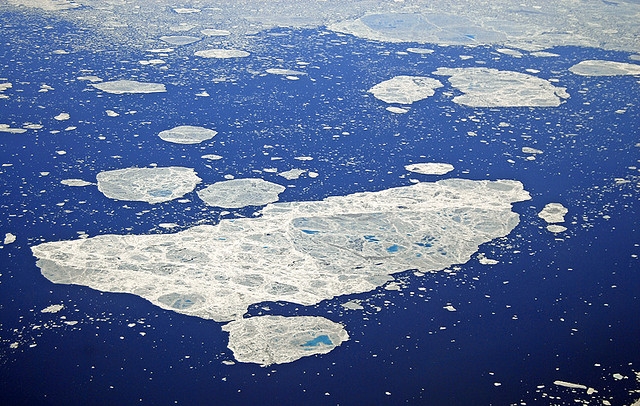
A regime shift towards a summer ice-free Arctic is occurring in response to Arctic warming that is demonstrated by reductions in sea ice surface area and ice volume during the summers. A summer ice-loss threshold, if not already passed, is expected to occur well within 21st century. The main driver behind the shift is the increased concentrations of greenhouse gases in the atmosphere – particularly CO2 that is contributing to the increase in average global temperature. Several feedback mechanisms have been proposed that may help maintain the reductions in Arctic ice under the new regime. The primary and best understood is the ice-albedo feedback mechanism where greenhouse gases are causing increased air temperature near the ground/ice surface leading to rapid decrease in ice surface area and volume. Current management strategies primarily relate to the decrease of greenhouse gas emissions on a global scale.

Evidence
Fig 1 | Empirical evidence. The databse currently documents 3 cases of arctic sea-ice loss around the world. Each dot in the map is coded from a scientific article documenting a place undergoing this regime shift. You can learn more from each case by hovering and clicking on the case of interest.
Analysis
General information
Alternative regimes
The system is defined by the ice volume and the territory it covers in the Arctic Ocean and the regional/global processes that ensure the existence of ice in this area. The loss of surface area and thinning of Arctic sea ice has not occurred at a linear rate which may be indicative of a systematic change towards an alternate regime.
Arctic with summer ice
Under this regime, the Arctic Ocean has an abundance of sea ice. It is characterized by very long and cold winters, during which the ice surface area and thickness reach their maximum. The low winter temperatures and short summer help to maximize the sea ice surface area and volume over time.
Arctic without summer ice
In this regime the surface area and volume of summer sea ice in the Arctic rapidly decreases due to atmospheric warming caused by greenhouse gases. In summer when open water surface area is greater, the albedo is reduced, which causes greater absorption of solar radiation. This raises the temperature of the water and ice, which facilitates greater losses in sea ice surface area and volume. Several models predict that ice free Arctic conditions in summer will be reached within this century (Arzel et al. 2006). Several authors have suggested that the system has already surpassed a tipping point, but convincing evidence is lacking (Lenton et al. 2008).
Drivers and causes of the regime shift
The main driver of this regime shift is elevated greenhouse gas concentrations in the atmosphere causing an increase in arctic air temperatures. This global driver is well established and could be looked as irreversible in the scale of next hundred years. In regards to the loss of sea ice in the Arctic, the regime shift is generally considered to be irreversible unless the main driver (increased atmospheric temperatures resulting from climate change) is changed in the near future.
Anthropogenic activities that elevate atmospheric greenhouse gas concentrations are generally considered to be the primary driver of climate change (IPCC 2007; Kinnard et. al 2011). Carbon release from anthropogenic sources is projected to continue and increase during the coming decades (IPCC 2007). This is expected to contribute to an increase in average global temperatures and more rapid decrease in sea ice cover and thickness in the Arctic. This driver initially affects the main ice-albedo mechanism thus changing the processes that characterize its initial state. Once the main mechanism has shifted the driver and the altered ice-albedo mechanism initiates change in other parts of the system.
Impacts on ecosystem services and human well-being
Local knowledge and spiritual values might be lost as the local communities have to adapt to the new circumstances and thus their lifestyle. In addition to concerns about the security of infrastructure and impacts on human well being, ice free Arctic summers have important impacts on ecosystems. One such impact is that loss of ice cover could affectthe Arctic’s freshwater system and surface energy budget, andmanifest in middle latitudes as altered patternsin atmospheric circulation and precipitation (Serreze et al. 2007). This presents the way how water and atmospheric circulations could be altered as ecosystem services.
Summer sea ice concentration is important for navigation, and may have implications for the transport of sediments and pollutants across the Arctic. Most of the sea ice formed in the Arctic Ocean is exported through the Fram Strait into the Greenland Sea and to the North Atlantic where the ice may affect the global thermohaline circulation (Rigor et al. 2002). Sea ice also blocks the solar flux to the water and hence is a major control factor phytoplankton to seals, walrus, and polar bears while limiting access to the surface for seals and whales (Lindsay et al. 2005).
The rapidly melting sea ice in the Arctic Ocean has increased political and economic interest in the region’s resource extraction and in the potential for more accessible shipping routes. By opening the Northwest passage, shipping route through the northern Canadian waters, could result in a positive economic impact. Although this also could potentially result in ecological disasters as the possibility of oil spills and other disasters associated with development would increase.
Management options
The options for preventing or reversing the loss of summer sea ice in the Arctic primarily relate to the decrease of greenhouse gas emissions on a global scale to reduce climatic warming. As atmospheric greenhouse gas concentrations increase, it is essential to understand local and regional actions that may influence the feedback mechanisms influencing the shift to an ice free summer Arctic. Technology transfer could be a good initiative from developed countries as they can provide more advanced technological solutions to developing countries to help accelerate the learning curve on GHG emissions. A Global response particularly from developed nations that are using the majority of the world’s resources on a per capita basis should be in place to deal with such complex system.
In-depth analysis
Feedback mechanisms
Arctic with summer ice
The ice-albedo mechanism (reinforcing, regional, well established): The permanent low surface air temperatures maintain the thermal balance thus ensuring balanced heat exchange between the atmosphere, sea ice, and water. The result is maintained sea ice volume, thickness and surface area. This occurs due to ensuring high albedo level as the dark ocean surface absorbs more solar radiation than the sea ice. This means that the high albedo reflects more radiation avoiding surface temperature increase. Avoiding increased absorption of solar energy promotes lower air, ice, water and land temperatures which lead towards maintaining sea ice. In the end, the low temperatures further promote ice maintaining arctic conditions.
Arctic without summer ice
The ice-albedo mechanism (reinforcing, regional, well established) Increased atmospheric greenhouse gas concentrations in atmosphere increase surface air temperatures that change the thermal balance. The result is a decrease in sea ice volume, thickness and surface area. The increased area of open water in summer decreases the albedo as the dark ocean surface absorbs more solar radiation than the sea ice. Increased absorption of solar energy promotes higher air, ice, water and land temperatures which lead towards degrading sea ice. In the end, the increasing temperatures and accumulated heat further promote warming arctic conditions.
The wind-ice circulation mechanism (reinforcing, regional/global, well established) Ice circulation patterns develop in response to wind and ocean currents. Retreating ice cover and increasing open water surface area generates a longer fetch for winds over the water surface. These altered surface winds result in morecyclonic motion of the ice and an enhanced transport of ice awayfrom the Siberian and Alaskan coasts. This change in circulation fostersopenings in the ice cover along the coasts. Although these openings quickly refreezein response to low winter surface air temperatures, coastal areas in spring are left with an anomalous coverage of young, thin ice. This thin ice then usually melts completely during the summer promoting stronger heat fluxes tothe atmosphere, which fosters higher surface air temperatures in the spring andearlier melt onset.
The wind-CHL mechanism (reinforcing, regional, not well understood) The loss of ice volume and resulting increase in open surface water are allowing increased wind fetch. The cold halocline layer (CHL) effectively shields the surface from heat stored at intermediate depths in the Atlantic layer. A study has shown a changing trend in wind patterns that cause a different distribution pattern of river water into the ocean. The relatively low input of river water into the Arctic Ocean can result in anomalously high salinities in the water that that links with the retreat of CHL. When warm Atlantic watersenter the Arctic Ocean, they form an intermediate layer of warm water as they subduct below the colder,fresher (less dense) arctic surface waters. The CHL separatesthe Atlantic and surface waters and largely insulates the ice fromthe heat of the Atlantic layer. The retreat of CHL is proposed toincrease Atlantic layer heat loss and ice-ocean heat exchange affecting the surface energy and mass balance of sea ice in Arctic.
The ice-currents mechanism (reinforcing, regional, speculative) A relationship between ice lossand oceanic warm water flux through the Bering Strait has been proposed. Delayed winter ice formation allows for more efficient coupling between theocean and wind forcing - a process that drives general circulation in Oceans. This redirects warm surface water from the Pacific Ocean from the shelf slopealong Alaska into the Arctic Ocean, where it may retard winter ice formation. In contrast, studies of river hydrographsdocument strong variabilityof river inflows into the Arctic without showing a distinctive long-term trend.
The precipitation-CHL mechanism (balancing, regional, contested) Increasing atmospheric temperatures and the following reduction of ice volume in Northern Hemisphere determine that the space of ice free water expands. Thus the evaporation from extended open water bodies increase leading to precipitation increase. If precipitation exceeds evaporation it leads to increased river runoff thus providing additional freshwater forcing. The CHL is strengthened by the cold freshwater input from the river runoff. Nevertheless as a result of wind energy input over large areas of open water internal wave induced mixing is enhanced that results in removing the CHL. This is proposed to increase Atlantic layer heat loss and ice-ocean heat exchange affecting the surface energy and mass balance of sea ice in Arctic. Thus increased precipitation and river runoff that strengthen the CHL could slow the depletion of Arctic ice by avoiding the warm Atlantic waters to intervene with the ice sheet. This is a balancing mechanism which means that after maintaining ice volume the open water surface will decline thus affecting precipitation and weakening CHL that further declines ice volume. Therefore other mechanisms could be dominating while this mechanism is in the balancing phase of ice decline instead of ice increase. If the wind-CHL mechanism is dominant over this mechanism then the loss of ice volume due to absence of CHL would still increase.
Drivers
The main driver of this regime shift is elevated greenhouse gas concentrations in the atmosphere causing an increase in arctic air temperatures. This global driver is well established and could be looked as irreversible in the scale of next hundred years. In regards to the loss of sea ice in the Arctic, the regime shift is generally considered to be irreversible unless the main driver (increased atmospheric temperatures resulting from climate change) is changed in the near future. Anthropogenic activities that elevate atmospheric greenhouse gas concentrations are generally considered to be the primary driver of climate change (IPCC 2007). Carbon release from anthropogenic sources is projected to continue and increase during the coming decades (IPCC 2007). This is expected to contribute to an increase in average global temperatures and more rapid decrease in sea ice cover and thickness in the Arctic. This driver initially affects the main ice-albedo mechanism thus changing the processes that characterize its initial state. Once the main mechanism has shifted the driver and the altered ice-albedo mechanism initiates change in other parts of the system. Greenhouse gas concentrations in the atmosphere and increasing temperatures are considered to be slow variables underlying this regime shift. The decrease in albedo and the resulting increase in the absorption of solar energy are the fast variables that are directly resulting in the decrease in Arctic sea ice.
The main external direct drivers that contribute to the shift include:
Greenhouse gas emissions (global; well established): Resulting increase in average global temperatures extend the area of open water in summer which in turn decreases the albedo that affects the absorption of solar energy therefore further degrading sea ice.
Slow internal system changes that contribute to the regime shift include:
Atmospheric temperatures (global; well established) This variable mainly affects ice volume variations throughout the year and in case of continuous depletion of Arctic sea ice it triggers various mechanisms that maintain the new regime of Arctic without summer sea ice.
Key thresholds Atmospheric temperatures: threshold at which thermal balance is established for promoting ice depleting or maintenance of arctic conditions
Leverage points Atmospheric temperature (global, well established): It is essential to alter increasing atmospheric temperatures as this event is ensuring the other processes that occur in this regime shift
River runoff (regional, ?): essential to alter in order to minimize the freshwater input in cold halocline layer and thus further decline of ice volume.
Albedo (local/regional, well established): altering low albedo would decrease the absorbtion of solar radiation thus avoiding atmospheric temperature increase and continuous loss of arctic ice.
Ecosystem service impacts
Local knowledge and spiritual and aesthetic values might be lost as the local communities have to adapt to the new circumstances and thus their lifestyle. Local wild animal and plant food diversity and fisheries would be affected as warmer conditions and less saline water would alter biodiversity and certain species would be extinct.
On the other hand, summer ice free Arctic would provide the access to new fisheries. The loss of ice cover could affect the Arctic’s freshwater system and surface energy budget, andmanifest in middle latitudes as altered patternsin atmospheric circulation and precipitation (Francis and Vavrus 2012). This presents the way how water and atmospheric circulations could be altered as ecosystem services.
Categorical summary
Impacts
Ecosystem type:’
- Marine & coastal
- Polar
Key ecosystem processes:
- Water cycling
Biodiversity:
- Biodiversity
Provisioning services:
- Fisheries
- Wild animal and plant foods
Regulating services:
- Climate regulation
- Water regulation
Cultural services:
- Aesthetic values
- Knowledge and educational values
- Spiritual and religious
Human well-being:
- Food and nutrition or Livelihoods and economic activity or Security of housing & infrastructure or Cultural or Aesthetic and recreational values
Links to other regime shifts:
- Thermohaline circulation
- Greenland ice sheet collapse
Drivers
Key drivers:
- Global climate change
Land use:
NA
Key attributes
Spatial scale:
- Sub-continental (e.g. southern Africa or Amazon basin)
Time scale:
- Decades
Reversibility:
- Irreversible (on 100 year time scale)
- Unknown
Evidence:
- Models
- Paleo-observation
- Contemporary observations
Confidence: existence of the regime shift
- Contested – Reasonable evidence both for and against the existence of RS
Confidence: mechanisms underlying the regime shift
- Well established – Wide agreement on the underlying mechanism
References
References old [Delete]
- Arzel O, Fichefet T, Goosse H. 2006. Sea ice evolution over the 20th and 21st centuries as simulated by current AOGCMs. Ocean Model 12,401.
- Bitz CM, and Roe GH. 2004. A mechanism for the high rate of sea ice thinning in the Arctic Ocean. J. Climate 17,3622–3631.
- Dickson RR, Osborn TJ, Hurrell JW, Meincke J, Blindheim J, Adlandsvik B, Vinje T, Alekseev G, Maslowski W. 2000. The Arctic Ocean Response to the North Atlantic Oscillation. J. Clim. 13,2671.
- Francis, J. A. & Vavrus, S. J. Evidence linking Arctic amplification to extreme weather in mid-latitudes. Geophys Res Lett 39, L06801– (2012).
- Holland MM, Bitz CM, and Tremblay B. 2006. Future abrupt reductions in the summer Arctic sea ice. Geophys. Res. Lett. 33
- IPCC 2007. Climate Change 2007: The Physical Science Basis. Cambridge University Press, New York.
- Johnson MA, and Polyakov IV. 2001. The Laptev Sea as a source for recent Arctic Ocean salinity changes, Geophys. Res. Lett., 28,2017-2020.
- Lenton TM, Held H, Kriegler E, Hall JW, Lucht W, Rahmstorf S, and Schellnhuber HJ. 2008.Tipping elements in the Earth’s climate system. PNAS 105(6),1786-1793.
- Lindsay RW, and Zhang. 2005. The Thinning of Arctic Sea Ice, 1988–2003: Have We Passed a Tipping Point? Journal of Climate 18(22),4879-4894.
- Prange M, and Lohman G. 2003. Effects of mid-Holocene river runoff on the Arctic ocean/sea-ice system: a numerical model study. The Holocene 13,335–342.
- Rigor IG, Wallace JM, and Colony RL. 2002. Response of sea ice to the Arctic Oscillation. J. Climate 15,2648–2668.
- Rigor IG, and Wallace JM. 2004. Variations in the age of sea-ice and summer sea-ice extent. Geophys. Res. Lett. 31.
- Serreze MC, Holland MM, Stroeve J. 2007. Perspectives on the Arctic’s Shrinking Sea-Ice Cover. Science 315(5818),1533 - 1536.
- Steele M, and Boyd T. 1998. Retreat of the cold halocline layer in the Arctic Ocean. J.Geophys. Res 103,10419–10435.
- Stroeve J, Holland MM, Meier W, Scambos T, and Serreze M. 2007. Arctic sea ice decline: Faster than forecast. Geophysical research letters 34.
- Zhang J, Rothrock D, and Steele M. 2000. Recent changes in Arctic sea ice: The interplay between ice dynamics and thermodynamics. J. Climate 13,3099–3114.
- Zhang X, and Walsh JE. 2006. Towards a seasonally ice-covered Arctic Ocean: Scenarios from the IPCC AR4 simulations. Journal of Climate 19,1730– 1747.
Citation
Acknowledge this review as:
Rolands Sadauskis, Reinette (Oonsie) Biggs, Garry Peterson, Juan Carlos Rocha. Arctic sea-ice loss. In: Regime Shift Database, www.regimeshifts.org. Last revised: 2011-02-27BibTeX citation:
@misc{
  author = {Rolands SadauskisReinette (Oonsie) Biggs and Garry Peterson and Juan Carlos Rocha},
  title = {Arctic sea-ice loss},
  url = {www.regimeshifts.org},
  howpublished = {Regime Shifts Database},
  publisher = {Stockholm Resilience Centre},
  institution = {Stockholm University}
}
This work is licensed under CC BY-NC-SA 4.0


 . It is an initiative lead by the Stockholm Resilience Centre. The website was developed by Juan Rocha and build with Rmarkdown.