Forest to savanna
Main contributors: Juan Carlos Rocha
Other contributors: Reinette (Oonsie) Biggs, Garry Peterson
Last update: 2011-02-28
Forest to savannas is a regime shift typical from tropical areas. Several feedback play an important role including albedo effects, evapotranspiration and clouds forming, fragmentation and fire-prone areas expansion, change in ocean circulation and self organizing vegetation patterns. However, not always these feedbacks are strong enough to produce alternative regimes; and in some areas shifts are expected to occur under stochastic events like ENSO droughts or unlikely events like Earth orbit change.
Evidence
Fig 1 | Empirical evidence. The databse currently documents 14 cases of forest to savanna around the world. Each dot in the map is coded from a scientific article documenting a place undergoing this regime shift. You can learn more from each case by hovering and clicking on the case of interest.
Analysis
General information
Alternative regimes
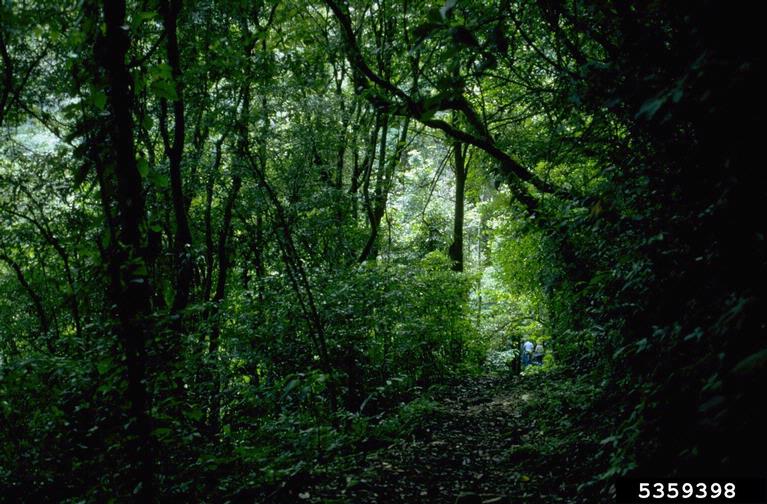
Forest regime
Forest are ecosystems typically dominated by trees, perennial plants
taller than 5 meters. Tropical forest includes moist and dry forest (MA,
2005). A mature tropical forest contain at least four layers: emergent
layer up to 45 - 80 meters tall, the canopy among 35 - 45 meters tall,
the understory layer and the floor layer. Such structure gives a variety
of habitats that host roughly half of the known plants and animals
biodiversity (MA, 2005).
Forest provides a wide range of ecosystem services. Besides being hot spots of biodiversity, forest provides soil and water protection, it prevents soil erosion, floods and landslides. For example, soil erosion may be 10-20 times higher on areas cleared of forest (MA, 2005). Depending on soil conditions, at the local scale forest can also regulate the hydrological cycles by increasing precipitation and decreasing evaporation. They regulate below grown runoff and smoothing seasonal extreme events: heavy rainfalls or dry spells. Due to its regulating function in the water cycle, forested watersheds provides water supply to one third of the world’s largest cities (MA, 2005).
Forest sustain about 200 million people belonging to indigenous groups, who depend on forest not only as source of resources (food, fiber, fuel) but also their culture and religious traditions (MA, 2005). Forest also maintain the agroforestry industry which, including temperate forests, produces 3.3 billion cubic meters of wood (MA, 2005).
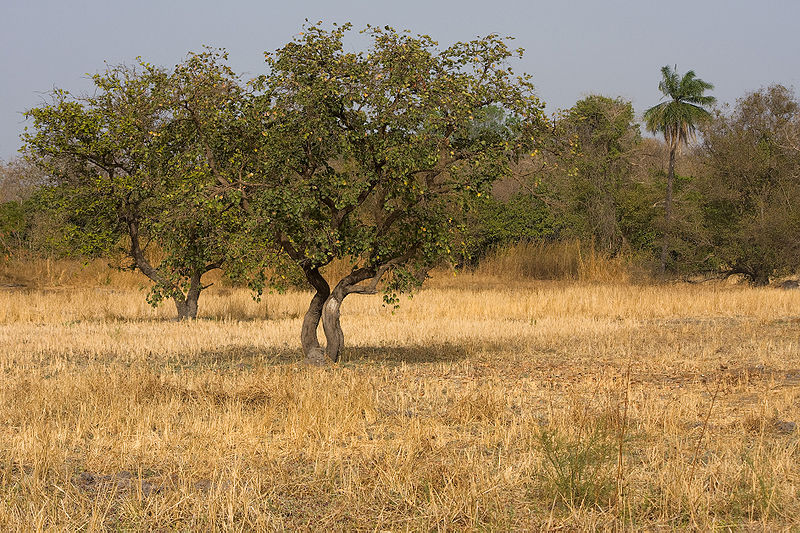
Savanna regime
Savannas, on the other hand, are drylands dominated by a mixture of
grasslands and shrublands. The canopy in savannas never closes, and the
floor layer is dominated by grass, especially C4 species. Savannas, dry
forest and shrublands conform 40% of the world’s land area and host up
to 42% of human population (Reynolds et al. 2007, Falkenmark and
Rockström 2008). About 25% of drylands, including savannas, are covered
by croplands and they sustain 50% of world’s livestock (MA, 2005).
Fire dynamics and grazing maintain the savanna regime. The feedbacks
that maintain both regimes includes the lifting condensation level
feedback, evapotranspiration feedback, roughness feedback, and
self-organized patchiness. However, the most important feedbacks
underlying change are fire feedbacks at the local scale and
albedo-moisture feedback in the regional scale.
* Albedo feedback (regional, well stablished): Albedo is the amount of
energy (light - heat) that is reflected to the atmosphere by earth
surface. Forested areas absorb more heat than bare soil or savannas,
increasing the gradient among land and ocean temperature. Such gradient
facilitates monsoon circulation which bring humidity from the oceans to
the land, increasing rainfall and therefore, optimal forest conditions
(Scheffer 2009). When tropical forest is replaced by less vegetated
cover like savannas, or ultimately by sand in deserts, net radiation at
the top of the atmosphere decreases inducing subsidence that inhibits
precipitation (Oyama and Nobre 2004). While in the tropics land clearing
affects the water balance and as consequence warms up the climate, in
boreal forest such clearing affects mainly albedo and as results cools
down climate (Foley et al. 2005). The albedo feedback is strengthen by
changes in land cover, typically induced by deforestation for logging or
agriculture activities. * Lifting condensation level feedback (regional,
well stablished): Lifting condensation level (LCL) (or cloud base
height, CBH) is the altitude at which cloud formation is initiated.
Warmer temperature and drier atmospheres, such as in savanna regime,
result in an increase in LCL that reduces the opportunity of cloud
formation and therefore the likelihood of rainfalls (Pinto et al. 2009).
To some extent, vegetation cover can modulate rainfall variability (Los
et al. 2006). * Evapotranspiration or physiological feedback (local,
contested): Plants that do not have enough water responds reducing
transpiration and photosynthesis, interrupting the supply of water vapor
that contribute to the recycled component of precipitation (Oyama and
Nobre 2004, Saleska et al. 2007). When transpiration reduction of each
plant is aggregated to the forest, less evapotranspiration blocks the
inland propagation of cold fronts responsible for precipitation,
increasing in turn the dry season length (Oyama and Nobre 2003, Pinto et
al. 2009). In such case, savanna vegetation is better adapted to dry
environments. Grasses usually have C4 photosynthesis type, a chemical
pathway that reduces water consumption and helps to cope with nitrogen
or CO2 limitations. Evapotranspiration depends on soil moisture and
biomass. Thus, for instance, droughts frequency or grazing reduce
biomass, weakening in turn the feedback effect (Dekker et al. 2007,
Dekker et al. 2010). In addition, the spatial distribution of rainfall
is affected by both the land-cover type and topography. Thus, in the
Amazon for example, massively deforested regions produce decrease of
precipitation, but near the edge at elevated regions like Los Andes,
precipitation increases (Da Silva et al. 2008). Besides, during El Niño
(ENSO) events, the system is more prone to rainfall reduction through
evapotranspiration feedback than during wet years, where the feedback is
not strong enough to produce such effect on climate (Da Silva et
al. 2008). In Dekker et al. (2007) model for instance, bistability is
only possible through stochastic disturbance (e.g. ENSO), inner dynamics
are not strong enough to produce alternative regimes. * Roughness
feedback (regional, well stablished): Roughness length is the height at
which wind speed is zero. It has to be with the surface elements that
stop wind and it is approximately one tenth of the hight of such
elements. Hence, forest roughness is higher than savanna roughness.
Reduction on roughness length in forests results in less mass
convergence around surface low pressure centers, decreasing the upward
moisture transport that feeds into convective precipitation clouds
(Oyama and Nobre 2004). * Fire feedbacks (Local, well stablished): At
the local scale, fire frequency can be easily altered. Deforestation
produce landscape fragmentation, which in turn creates fire-prone
habitats in patch edges. Hence, cattle pastures and regrowth forest
areas become increasingly prone to frequent fires. In such zones fire
can be produced after few days of dry conditions. On the regional scale,
fire smoke may reduce rainfall by trapping moisture and inhibiting
raindrops formation (Laurance and Williamson 2001). Fire plays a
fundamental role in the shift from forest to savanna since it is a
feedback that actually maintain savanna state (Laurance and Williamson
2001, Hutyra et al. 2005) * Self-organizing patchiness in arid
ecosystems (local, well stablished): Rietkerk et al. (2004) describe a
couple of feedbacks that explains self-organized patchiness in
ecosystems as a scale-dependent mechanism. It is most likely to happen
in water-limited systems, including savannas. The first feedback
mechanism is a positive one in the short spatial range where higher
vegetation density allows lower evaporation and higher water
infiltration through shading and root penetration respectively. These
conditions allow plant recruitment. The negative feedback emerge in the
long spatial range where bare or poor soils do not allow vegetation to
establish. Therefore, it maintain dry states and inhibits the
reestablishment of forest. Further regime shifts among dry states may
happen when the islands of fertility are cleared because the chance to
recolonize are minimal. Hence, deforestation, fire, land degradation,
and grazing are disturbances that may interact and shift the system to
drier regimes.
Drivers and causes of the regime shift
The most widely recognized driver is deforestation and consequently fragmentation of forest landscape, which reduces rainfall and increases surface temperature (Da Silva et al. 2008, Nobre et al. 2009). Reduction of forest cover accelerates albedo effect, loss of evapotranspiration and roughness length (Sternberg 2001), activate fire feedback, change ocean circulation and warms up sea surface in the Amazon case, and ultimately change the spatial organization of vegetation.
Deforestation and forest degradation is in turn driven by a complex, case specific interaction of social and economic drivers. The most important reported drivers are agriculture expansion, infrastructure development, the logging industry and fast population growth; standing out in most cases (Geist and Lambin 2002, MA, 2005). For example, in the Amazon, illegal logging is a critical threat that besides its damage to the forest, bring with them secondary effects like expansion of hunting areas, slash-and-burn farms, mining, the establishment of new road networks and therefore more logging facilities. The MA (2005) reports that 70 countries have problems with illegal logging leading to national income losses of $5 billions and total economic losses of about $10 billion. By 2001, Laurance and Williamson (2001) reported that 80% of brazilian logging activity were illegal; however, government counterintuitively sponsored colonization through cattle ranching projects.
On the other hand, population growth seems to play a dual role. While colonialism (in-migration) prevail in Latin American cases, in Asia and Africa fast local population growth is what intensifies logging and forest pressure (Geist and Lambin 2002). Deforestation responds to social feedbacks characterized by poverty traps. The gap among rich and poor people left some of them with the only alternative to find livelihoods by exploiting primary resources such as forest. Furthermore, illegal markets accelerate such dependency by creating the opportunity to trade wood.
Climate change and global warming are expected to enhance the regime shift; and the loss of forest areas are expected to exacerbate climate change (Laurance and Williamson 2001, Bonan 2008). While Laurance and Williamson (2001) report that forest like Amazon apparently change from carbon sinks to carbon sources during ENSO events; Nobre et al. (2009) suggest that deforestation of Amazon may actually increase ENSO variability; and Bonan (2008) confirms that deforestation would enhance global warming by decrease of evaporative cooling and release of carbon dioxide.
Impacts on ecosystem services and human well-being
NA
Management options
Managerial options for the forest to savanna regime shifts target its main drivers: deforestation and landscape fragmentation. Controlling illegal logging and implementing sustainable logging plans are part of the strategy. Sustainable logging needs to take into consideration reducing fragmentation and allow deforested patches to regrowth. Likewise, the expansion of agricultural frontier and grazing areas needs to be controlled; and when unavoidable, it needs to be planned in order to prevent fragmentation. The fire frequency feedback accelerates the shift from forest to savanna regime. Laurance and Williamson (2001) suggest fundamental changes in prevailing land-use practices and development policies to avoid wildfires. Such changes include the management of logging and grazing areas in order to reduce fragmentation and therefore it would reduce the fire risk. Hence, fire and fragmentation management need to be coupled strategies.
In-depth analysis
[1] “This regime shift does not have a feedback analysis yet”
Categorical summary
Impacts
Ecosystem type:’
- Tropical forests
- Moist savannas & woodlands
- Grasslands
Key ecosystem processes:
- Soil formation
- Primary production
- Nutrient cycling
- Water cycling
Biodiversity:
- Biodiversity
Provisioning services:
- Freshwater
- Food crops
- Livestock
- Wild animal and plant foods
- Timber
- Woodfuel
Regulating services:
- Climate regulation
- Water regulation
- Regulation of soil erosion
- Pest & disease regulation
- Natural hazard regulation
Cultural services:
- Recreation
- Aesthetic values
- Knowledge and educational values
- Spiritual and religious
Human well-being:
- Food and nutrition or Health (e.g. toxins or disease) or Livelihoods and economic activity or Security of housing & infrastructure or Cultural or Aesthetic and recreational values or Social conflict
Links to other regime shifts:
NA
Drivers
Key drivers:
- Vegetation conversion and habitat fragmentation or Harvest and resource consumption or Infrastructure development (e.g. roads or pipelines) or Soil erosion & land degradation or Environmental shocks (e.g. fire or floods or droughts) or Global climate change
Land use:
- Small-scale subsistence crop cultivation or Extensive livestock production (natural rangelands) or Timber production
Key attributes
Spatial scale:
- Sub-continental (e.g. southern Africa or Amazon basin)
Time scale:
- Decades
Reversibility:
- Hysteretic (difficult to reverse)
Evidence:
- Models
- Paleo-observation
- Contemporary observations
Confidence: existence of the regime shift
- Well established – Wide agreement in the literature that the RS exists
Confidence: mechanisms underlying the regime shift
- Contested – Multiple proposed mechanisms, reasonable evidence both for and against different mechanisms
References
References old [Delete]
- Bonan, G. 2008. Forests and climate change: Forcings, feedbacks, and the climate benefits of forests. Science 320:1444-1449.
- Da Silva, R., D. Werth, and R. Avissar. 2008. Regional impacts of future land-cover changes on the amazon basin wet-season climate. J Climate 21:1153-1170.
- Dekker, S. C., H. J. de Boer, V. Brovkin, K. Fraedrich, M. J. Wassen, and M. Rietkerk. 2010. Biogeophysical feedbacks trigger shifts in the modelled vegetation-atmosphere system at multiple scales. BIOGEOSCIENCES 7:1237-1245.
- Dekker, S. C., M. Rietkerk, and M. F. P. Bierkens. 2007. Coupling microscale vegetation-soil water and macroscale vegetation-precipitation feedbacks in semiarid ecosystems. Global Change Biol 13:671-678.
- Falkenmark, M. and J. Rockström. 2008. Building resilience to drought in desertification-prone savannas in Sub-Saharan Africa: The water perspective. Nat. Resour. Forum 32:93-102.
- Foley, J., R. DeFries, G. Asner, C. Barford, G. Bonan, S. Carpenter, F. Chapin, M. Coe, G. Daily, and H. Gibbs. 2005. Global consequences of land use. Science 309:570-574.
- Geist, H. and E. Lambin. 2002. Proximate causes and underlying driving forces of tropical deforestation. BioScience 52:143-150.
- Hutyra, L., J. Munger, C. Nobre, S. Saleska, S. Vieira, and S. Wofsy. 2005. Climatic variability and vegetation vulnerability in Amazonia. Geophys Res Lett 32:L24712.
- Laurance, W. and G. Williamson. 2001. Positive feedbacks among forest fragmentation, drought, and climate change in the Amazon. Conservation biology 15:1529-1535.
- Los, S. O., G. P. Weedon, P. R. J. North, J. D. Kaduk, C. M. Taylor, and P. M. Cox. 2006. An observation-based estimate of the strength of rainfall-vegetation interactions in the Sahel. Geophys Res Lett 33:L16402.
- Millennium Ecosystem Assessment. 2005. Ecosystems and human well-being: synthesis?.137.
- Nobre, P., M. Malagutti, D. F. Urbano, R. A. F. De Almeida, and E. Giarolla. 2009. Amazon Deforestation and Climate Change in a Coupled Model Simulation. J Climate 22:5686.
- Oyama, M. and C. Nobre. 2003. A new climate-vegetation equilibrium state for tropical South America. Geophys Res Lett 30:2199.
- Oyama, M. and C. Nobre. 2004. Climatic consequences of a large-scale desertification in northeast Brazil: A GCM simulation study. J Climate 17:3203-3213.
- Pinto, E., Y. Shin, S. A. Cowling, and C. D. Jones. 2009. Past, present and future vegetation-cloud feedbacks in the Amazon Basin. Clim Dynam 32:741-751.
- Reynolds, J., D. Smith, E. Lambin, T. Ii, B L, M. Mortimore, S. Batterbury, T. Downing, H. Dowlatabadi, R. Fernandez, J. Herrick, E. Huber-Sannwald, H. Jiang, R. Leemans, T. Lynam, F. Maestre, M. Ayarza, and B. Walker. 2007. Global Desertification: Building a Science for Dryland Development. Science 316:847.
- Rietkerk, M., S. Dekker, P. de Ruiter, and J. van de Koppel. 2004. Self-organized patchiness and catastrophic shifts in ecosystems. Science 305:1926-1929.
- Saleska, S., K. Didan, A. Huete, and H. da Rocha. 2007. Amazon forests green-up during 2005 drought. Science 318:612-612.
- Scheffer, M. 2009. Critical transitions in nature and society.
- Sternberg, L. 2001. Savanna-forest hysteresis in the tropics. Global Ecology and Biogeography:369-378.
Citation
Acknowledge this review as:
Juan Carlos Rocha, Reinette (Oonsie) Biggs, Garry Peterson. Forest to savanna. In: Regime Shift Database, www.regimeshifts.org. Last revised: 2011-02-28BibTeX citation:
@misc{
  author = {Juan Carlos RochaReinette (Oonsie) Biggs and Garry Peterson},
  title = {Forest to savanna},
  url = {www.regimeshifts.org},
  howpublished = {Regime Shifts Database},
  publisher = {Stockholm Resilience Centre},
  institution = {Stockholm University}
}
This work is licensed under CC BY-NC-SA 4.0


 . It is an initiative lead by the Stockholm Resilience Centre. The website was developed by Juan Rocha and build with Rmarkdown.